
Markus Reuter is a German touch guitarist. A student of Robert Fripp’s Guitar Circle, Markus made a name for himself because of his unique approach to composition and his quite fearsome abilities with the touch guitar and on bass. Markus is also a producer and instrument designer, having worked on creating his own line of touch guitars. As a member of the improvised music group centrozoon, Markus has collaborated on 3 releases with Tim Bowness. This piece is being published in conjunction with my new website Words On Tape
What exactly are the origins of centrozoon and why did you decide to make a group centered around improvised pieces of music?
Improvised music has, my interest since the early nineties. In around 1996 I met Bernhard Wöstheinrich. He had the band centrozoon before me with some other guys. It just a trio for a while with a guy called Thorsten Niestrath. He left, so it just left Bernhard and me. We had so much fun together playing together and we lived relatively close from each other, like a 20 minute train ride, so we met once per week to play together for years. It just was just something we enjoyed, you know, I was sort of like our hobby, even though we played a few gigs, even from the very beginning that we got together. Bernhard didn’t go to music school, he didn’t know anything about theory, but what he did was like completely free. I had been classically trained so it was super inspiring to me to work with somebody who was so free and almost used the synthesizers and sequencers like paint on a canvas. It was a perfect match. It’s difficult to find a partner in life, but finding a musical partner is even harder in a way. I got so lucky in my life to have met quite a few people where it really clicked. I still see Bernhard almost every day, even though we don’t play together much anymore. We play maybe once or twice a year, but that’s about it at the moment.
How did Tim Bowness get involved with centrozoon? What exactly did his collaboration entail?
I had met Tim online on a mailing list, I think in the late nineties or around 2000 or 2001. I ended up visiting him in Norwich, where he used to live back then. We spent a couple days together, walking through the city, talking about and listening to music and we became friends. I came back to Germany and I said to Bernhard, ‘let’s, let’s just invite him and see what happens.’ We got together and we had a friend there, Philipp Quaet-Faslem, who was recording us. It was like the old days where we didn’t have money for good equipment. It was all very basic in regards to technology, but it was an inspired session. All the music that Tim, Bernhard and I created together was created in about 24 to 30 hours or something like that. What was so amazing, and I’ve only ever experienced that once again in my career, but only once, is that Tim actually had these lyrical ideas. They were just individual words and some phrases that he was improvising, but he was coming up with the lyrics and the melodies as we were playing the pieces together. We gave Bernhard maybe 10 to 15 minutes before each recording session to prepare something in his groove box, which was something we used before the days of using laptops. So he’d prepared something, which was just like two bar based pattern, maybe with some chords or like some percussive elements, and that was always the starting point for the improvisations. The riffs, the melodies, and all the, the harmonic content came together in the improvisation. We were so impressed with Tim’s ability to improvise on that level of lyrics. He came up with these strong phases like in “10 Versions of America.” It was so powerful and all improvised.
Never Trust The Way You Are had some delays, as it was supposed to come out in 2005. It was the first time we had real production. Before that we just recorded live to two track. It was the start of a very long but good learning curve for me. We actually found a label that wanted to put it out. The label actually went bust the moment the order was placed at the pressing plant. We had around 5000 copies that we had bought from the pressing plant, meaning that there are actual CD’s of the album out there! We just couldn’t let that be destroyed. We also played some shows in Germany that were semi-improvised. We had the basic drum patterns for the songs, but the rest was largely improvised.
How did you get involved with Tim’s 2004 album My Hotel Year?
There are two pieces on that album I was involved with. ”The Me I Know” is a piece that we had written and played as centrozoon and it was sort of his ‘cover version’ on the album. It was not on the centrozoon album Never Trust The Way You Are but was on the EP The Scene of Crash and Burn. We contributed it to his solo album. I had also started writing pieces with Ian Body called Pure. I think I did maybe 20 demos? 10 of them ended up on Pure. Some of the others ended up on an album I did with Pat Mastelotto under the name Tuner called Totem. So this one leftover piece, “I Once Loved You,” ended up on Tim’s album.
Where does your involvement with Stick Men come from?
In 2005 Pat called me and basically said “Markus, I have the time, I have the protools set up, let’s make a record!” I felt I was interning while we were working on music together. I spent a good five years with him just learning in the studio. While I was at Pat’s house working on the Tuner record Totem, Tony Levin had started work on a solo album called Stick Man. He had asked Pat to be the drummer for that record. Then they started this trio with Michael Bernier. I remember I was there at the moment that Pat received the files from Tony and started adding his drums to it. I was kind of there at the beginning of the band but I wasn’t in the band.
Michael had been chosen by Tony because he was local and all, but Pat told me later that he would have liked to have me in the band from the very beginning. I remember saying to Pat around 2009 or so that it would be great if I toured more. And about 9 months later, he emailed me asking if I’d like to join Stick Men. I told him that I’d have to sleep on it, which some people would say is crazy. I needed to kind of understand what my could my role be in the band. Our first rehearsals together weren’t actually rehearsals but writing sessions. I think on the very first day we wrote the piece Crack in the Sky together. It was quite clear from the beginning that it was a good fit.
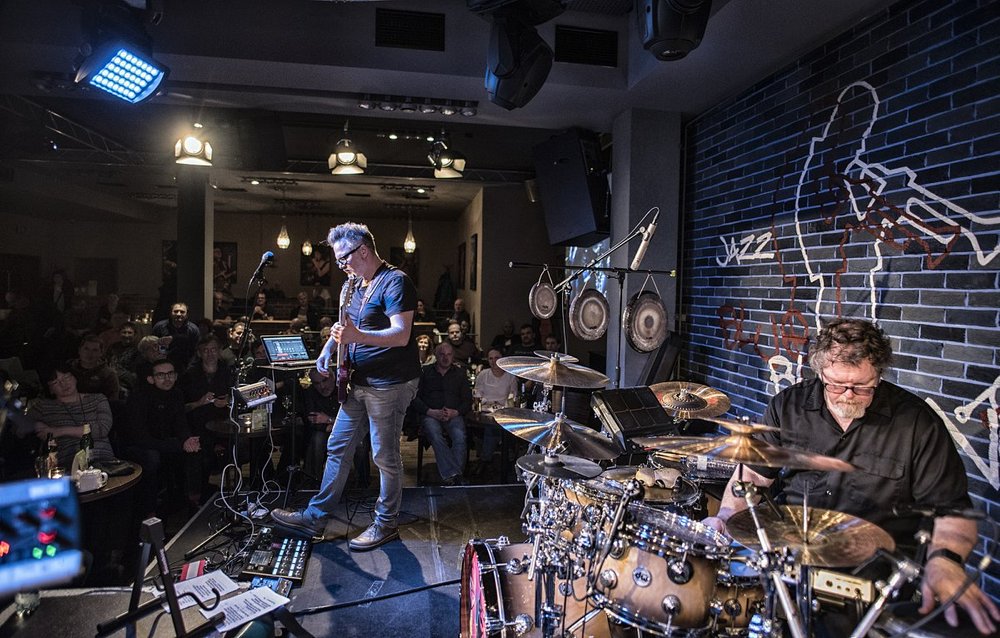
What challenges do adding additional members to Stick Men’s live shows (such as David Cross and Mel Collins) bring?
Since Tony and Pat are the rhythm section, nothing much changes really. They just play the the same thing they play. So its about me kind of organizing how to share certain melodies or to decide which solo sports are going to be given to the guests. With both David and Mel it was super intuitive and easy. It was especially so with David since we played so many shows with him. We also did a full South American tour with him. In a way it was almost like it was completing the band. With a trio, it’s pretty hard to pull off a full sound like we do with Stick Men. Having David there means I can do much more. Within a 20 minute stretch of a show, I don’t have a single second to take my fingers off of the instrument or touch the fader on my monitor mix. As the lead guitar and soundscaper, I’m busy all of the time. Having David there let me have these moments where I could have a breather or play something more detailed.
What made you seek out the teaching of Robert Fripp and Guitar Circle?
I was 18 when I cam across King Crimson, so I was pretty late to the party. I had fallen in love with Discipline in 1990. I heard “Elephant Talk” and knew this is the kind of music that I was imagining and here’s the band that was doing it. I knew about Robert because he played on the record. I found in a local music magazine an ad for a concert by Robert and the league of crafty guitarists. It was a great show. There were flyers on the table there for Guitar Craft courses that was happening in the summer of 1991 in Switzerland. For some reason I managed to convince my parents to pay for the course for me and to get a guitar. It wasn’t so much of Robert’s reputation but the music of King Crimson that drew me in. I knew that there was something and here and worth studying for me. Once I was there, I realized that for a lot of people, he was some sort of guru figure. For me, he was one of the greatest teaches I’ve ever met. He was so good, I didn’t need many meetings with him. He managed to pass on the knowledge in a very short period of time.
You were involved with a very unusual improv based album featuring Toyah Wilcox. Reflect on that.
The session was set up by the Humans and Tuner. At that point the Humans where Chris Wong, Bill Reiflin and Toyah. A friend of ours who was the ambassador of Estonia organized the Fragile Moments project. It was based off of this Estonian project called Fragile which was Robert Jürjendal and Arvo Urb. These two guys would play together and improvise together The idea was to bring Toyah, Chris and me in. All of the music you hear on that album was played exactly like that in the studio. As far as I remember, there were no overdubs. It was one of the first albums that I mixed and produced. We were all in the same room, even the drums and vocals. My friend Lee Fletcher helped me with the vocal production, Lee was also part of the albums with Tim.
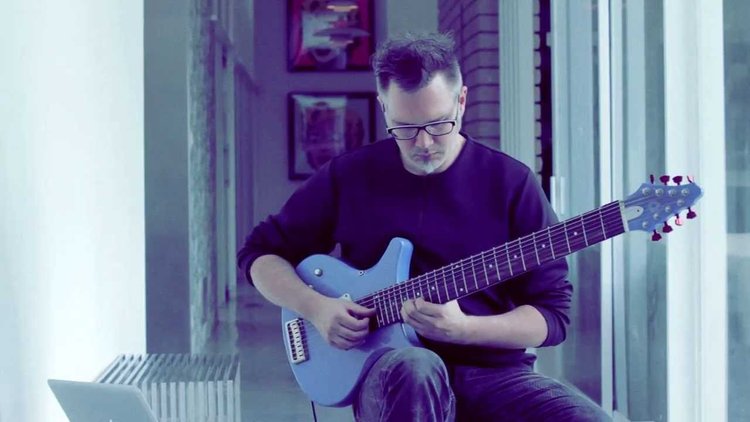
What made you want to design your own series of Touch Guitars?
I realized that I had accumulated so much knowledge about the playing technique, that it was becoming interesting to see if an instrument was actually built from the perspective of a person who knows how to play it. Some of the design features of the other instruments that were around back then were designed by people who are not really players. I had a meeting with Robert Fripp at a festival in Portugal. He asked me, ‘Markus, how are you making a living as a musician? You’re one of the few students who is a lifer.’ During the conversation, I could feel something forming in the back of my head, which was this realization that I had only been creating idealistic pieces of art. So not something that was physical in the sense of more like a CD. I also remember at that point thinking if I can show my parents a guitar, finally they will know what I do. I was lucky to meet a great luthier who I spent time with and built the first 10 instruments with. The prototype instrument was such a revelation. Its actually the instrument on the Fragile Moments record. It changed my whole life because everything went from a being a little bit of a struggle to something joyful. The touch guitar company has existed for 14 years. I gave the license away to some other guy and I’m not involved anymore. I didn’t want to be involved with the organizational aspect of it.
What was it like working with Steven Wilson on Grace for Drowning?
Steven had asked Pat to do some remixes of his album Insurgentes. I had developed this strange editing process that Pat then asked me to apply to the material. I had come up with a system to do these metric modulations but based on the original recordings. It was involving some math like stretching seven notes into the space of eight. I remember that I did play on quite a few parts on those remixes. So when Steven asked Pat to play on Grace for Drowning, he must have also asked me to play on something too.
What caused you to decide to start your own podcast series?
It was sort of an unintended response to COVID times. In January I wanted to start this new series of doing public touch guitar lessons with my friend. Sean Crowder, whose a drummer. He wanted to show people that you could learn this instrument in a year. We are still doing documentary style videos that are on YouTube. I had a 45 minute conversation with Sean back in November. I said to myself, ‘Okay, why don’t I just put this out as a sort of podcast, an open conversation about whatever topics come up. That was the beginning of it. I think the second episode was with Sid Smith, so a wonderful conversation. At that point I started recording one conversation a week. That become two and then three. I’ve recorded maybe 65 of them, with 52 or 53 having been released. Some of my partners in these conversations have said that its almost like doing therapy.
Why do you think the music of King Crimson has this impact on people and continues to be an influence all these years later?
Because of the compositions is my answer. As far as I’m concerned, there is something unique about the way they have these distinct phases and lineups. There’s also looking another way there’s different kinds of writing. You can find these very particular, almost closed, systems within how the band operated. I don’t know if anyone would agree with me, but King Crimson is sort of like the Beatles in popular culture. Nobody really calls that out but its true.

 All The Blue Changes