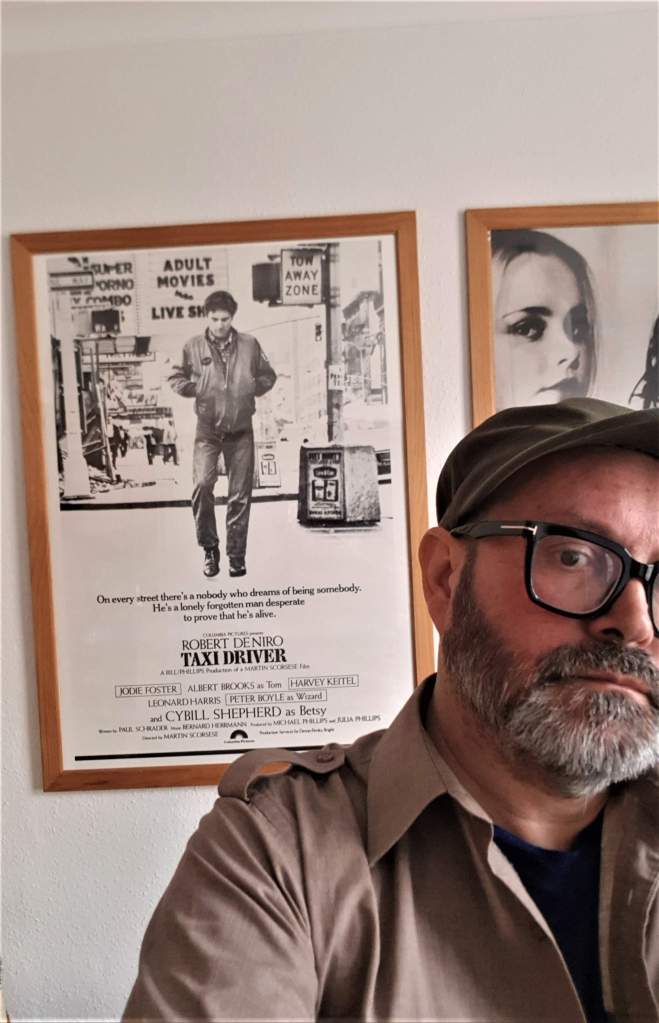
Philip Ilson is a British filmmaker who created the distinctive live projections and directed two music videos for No-Man. He is currently the artistic director of the London Short Film Festival for 2021.
How did you first hear about and get involved with the band?
Quite a roundabout convoluted route. It’s a long story! As a bit of background, I’d studied photography and had been in my own indie bands in the 80s (not very successful – Bull & Gate indie circuit). I’d also photographed some friends bands as well as being involved in some low-budget filmmaking with my old schoolfriend Tim Harding, using our Dad’s super and video cameras. In the late 80s, I temped at an oil company (just an Office Angels clerical temp role to earn money), and I met a guy (another temp), John Mason, who played bass in his old uni band (from Thames Poly, called The Go Hole). We became really good friends and I saw the band a few times (they had an indie single out that was being well recieved), and as the 80s turned to the 90s, and psychedelic indie-dance was becoming a thing off the back of Primal Scream’s ‘Screamadelica’, so The Go Hole changed their name to Sp!n, and I took on the role of supplying live visuals, using old super 8 projectors and slide projectors, using what I’d learnt from my photography and filmmaking days. The band got signed to producer Stephen Street’s (The Smiths) label, Foundation, and they started touring the country – indie clubs and student union bars, and support slots for the likes of The Darling Buds and A Thousand Yard Stare.
One of the London clubs that Sp!n played was called The Flag, which was an odd choice as it was mainly electronic Goth bands that played there, kind of with a Gary Numan influence. The guy who ran it, called Frank (I think), said he had a band who’d played the club a few times called Noman, and they were interested in a live visual element, and he put me in touch with Steven Wilson to discuss.
Just to follow on the Sp!n story for a moment, I toured extensively for a couple of years with them around the UK, either in the band tour van or my own car. Unfortunately, one night, they had an accident on the M40 motorway (I was in my own car that night, as my then girlfriend was with me) coming back from a gig in Dudley. No one was killed, but John had extensive brain damage after being in a coma for 11 days. The band didn’t split up (though John could no longer continue on bass), but the singer also left (which he was planning to do before the accident), and they recruited a new singer Martin Rossiter, and recorded a new single and continued playing live, with me continuing on the visuals, even playing a gig in Switzerland supporting Echo & the Bunnymen and The La’s. But it all seemed over for them, so they went through a major period of re-invention, changing their name to Gene, and moving toward a more Mod / Britpop sound – no psychedlia, no visuals required, which was fine by me, as I wasn’t really into continuing. Though as you may know, with this name change and new sound, Gene did break through in the Britpop 90s and had considerable success touring the world, appearing on Top of the Pops, well into the early 00s.
What would you say your role was in regards to the live shows and how did that change over time?
Interestingly, I’m not too sure what I did for the early Noman gigs where I created visuals, and to be honest, I’m not too sure where my involvement started with them. As I already had the visual stuff (film loops and slides) I was using for Sp!n, thinking back I doubt very much I would’ve re-cycled that stuff for Noman, which wouldn’t have been fair. As Noman were signed to One Little Indian, they had a budget (also, this was different to working for Sp!n as this had evolved through my friendship with them), so thinking back, maybe the first visuals I did were what they commissioned – the ones that got used at the Clapham Grand show.
Also, it wasn’t just me – I mentioned my old friend Tim, and he was very present in creating the work we made for Noman visual projections. I know we shot on 16mm film, like a short film to go with various tracks, and we shot set-ups using our girlfriends and other friends, dressed at the Virgin Mary, Krishna, an angel, or rolling around in flowers. I think these were what premiered at the Clapham Grand.
How did the backing projections evolve over the various live shows from that era?
I don’t think they did. The films we made were the films that were used, but I’m not sure where else they were played out, in terms of other gigs.
Do any of these backing projections still survive and if so, any way to see them?
Yes, I have a whole archive of film stuff I made, and the 16mm rolls exist, as do the masters of the music videos.
What was the artistic vision behind the Sweetheart Raw and You Grow More Beautiful videos?
Again, these were collaborative projects between me and Tim (Harding). Our whole aesthetic at that time was kitsch religious iconography, gaudy colours, and a low-budget aesthetic of double-exposure – we’d made some other short films, about Adam & Eve, about fairies on stone circles, 50s style B&W horror. There was also some flower imagery crossover from the Sp!n visuals. A lot of this imagery fitted with the romanticism of Noman’s music and lyrics at the time, so it was a good creative marriage.
Were you involved with the Only Baby video? (Tim won’t share much beyond that it was dreadful!)
Good question! I can’t remember. Was this the one where they thought as a more commercial ‘pop’ single, it would requite a more commercial video? I’d have to go into the archive.
Do you have any photos from any of the live shows? I haven’t been able to find anything for the 1993 tour and only a handful of photos from the 1992 tour.
Yes, I have a few of the Clapham Grand show (though they’re not very good), and also a fair amount of photos of us making the visuals and the music videos.
Have you followed the band’s work in the time since?
It was no secret to Tim and Steven that Noman wasn’t really my kind of thing musically. Of course, I loved working on the videos and shows, and got to love those songs of that period, but once I’d stopped working with them, I didn’t hear any later stuff. Same with Porcupine Tree; I don’t think I’ve ever heard anything by Porcupine Tree.
Facebook has allowed me to stay in touch a little bit with people I met through Noman even if I don’t see them – I see Michael Bearpark’s posts, and have followed what Peter Chilvers has been doing with Brian Eno, and when I visit Alison and Tim in Guilford, we talk about other people from that time: producer David Kosten, and other musicians, but with Tim and Steven not really on social media, I’ve lost touch with them.
Also, everything you do, particually in the creative world, leads to the things you end up doing, and all the work I did in film, photography, visuals and music, lead to my current roles in film festivals, for sure.

 All The Blue Changes